







Shop/Products // Smart Tilt Sensors //

Smart Tilt Sensors

A smart tilt sensor is a device that measures the slope or orientation of a given object relative to the gravity of the Earth. Most rudimentary tilt sensors use gravity to shift and internal mechanism like a metal ball to make or break an electrical connection and warn of obscurity. A modern sensor uses microelectromechanical systems (MEMS), gyroscopes, or accelerometers to calculate exact angle measurements over single or multiple axes.


An intelligent tilt sensor can be commonly used in industrial safety practices to prevent the tipping of any heavy machinery or equipment, or in the monitoring of structural stability where settling in large structures needs to be taken into account. They can also be used to detect tampering and to check levelling in everyday use.
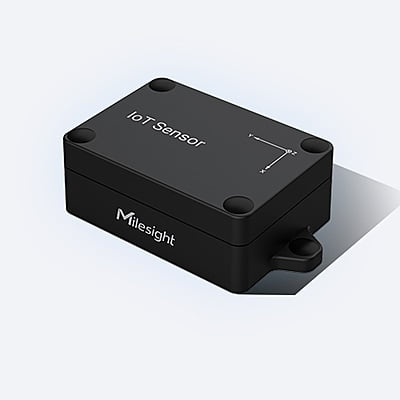

Smart Tilt Sensors

Milesight EM310 LoRaWAN Tilt Sensor
£59.00
Milesight EM320 LoRaWAN Tilt Sensor
£69.00

FAQ

How do tilt sensors work?

Many tilt sensors are gravity-based, sensing shifts with internal mechanisms and alerting when this is triggered. Some use rolling balls that bridge two internal contact pins when tilted, and some use conductive fluid inside a small chamber with many electrodes to measure changes. Solid-state MEMs use microscopic silicon structures to sense acceleration and orientation with great accuracy.

What are the different types of smart tilt sensors?

There are various types of smart tilt sensor, and it depends on what you're referring to. If you're looking at axis measurement:

  • Single-axis measures tilt along one direction only.
  • Dual-axis measures tilt across the X and Y axes simultaneously.
  • Triaxial measures across X, Y, and Z axes for 3D posture tracking.

If you're looking at the operational end:
  • MEMS (microelectromechanical systems) use solid-state capacitive or accelerometer chips.
  • Gyroscope-based tilt sensors use rotational motion analysis to track dynamic tilt and orientation changes.
  • Electrolytic / Fluid-filled sensors use a conductive liquid inside a small shell with electrodes that change electrical current as the liquid shifts.
  • Force balance / pendulum sensors use a suspended weight paired with a servo system for accurate measurement in industrial and structural monitoring.
  • Mechanical / rolling ball sensors use rolling weights that touch contacts to close an electrical circuit when tilted past a point.
What are the benefits of using a smart tilt sensor?

If you're in a heavy industrial environment, there are multiple pieces of equipment and machinery that have the potential to fall and injure people. Employing the use of a tilt sensor can alert you to any shifts before they become problems. If you have objects that need to be kept in place without being physically nailed down, a tilt sensor can help with this and alert of tampering.

Items have been added to cart.
One or more items could not be added to cart due to certain restrictions.
Added to cart
- There was an error adding to cart. Please try again.
Quantity updated
- An error occurred. Please try again later.
Deleted from cart
- Can't delete this product from the cart at the moment. Please try again later.
