





Shop/Products // Lighting Control //

Smart Lighting Controllers

Smart lighting control puts luminaires under the same schedules, setbacks and central oversight as the rest of your building services. Lights that are controlled with smart technology respond to occupancy, daylight and time of day, and report their status back to the building management system.


Our range covers DALI gateways for connecting existing DALI installations to BACnet or Modbus, analogue dimming modules for 0 to 10V drivers, and wireless relay controllers for switching circuits where dimming is not required.


Lighting is typically one of the largest electrical loads in a commercial building and among the easiest to reduce, since much of the waste is simply lights burning in empty or already daylit spaces. Because control is wireless, most of these products retrofit into existing installations without new control cabling.

Smart Lighting Control

Milesight WS558 Smart Light Controller
£116.00
SR65 Outdoor Temperature Sensor
£90.48
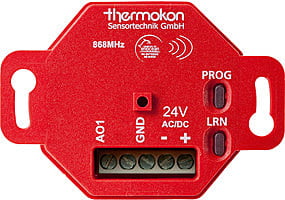
Thermokon SRC AO DIM V
£89.00
Deuta DALI EnOcean Broadcast
£99.00
Intesis DALI-2 to Modbus TCP & RTU or BACnet/IP & MS/TP Server Application with 1 DALI Channel
£579.00

FAQ

How much energy can lighting controls save?

Savings depend heavily on the building and what is already in place, so treat any single figure with caution. The broad pattern is well established, though. Occupancy sensing tends to deliver the largest single share, with reductions of roughly 24 to 50 percent depending on the type of space and how it is used, while daylight harvesting adds a further 28 to 40 percent in perimeter and rooflit zones.


The important detail is that these savings sit on top of any lamp upgrade, not instead of it. A building that has already halved its lighting energy by moving from fluorescent to LED can typically cut what remains again by adding controls.


Where the savings actually come from is unglamorous: lights burning in empty rooms, lights at full output next to a bright window, and lights left on overnight and at weekends. The more variable a building's occupancy, the larger the return. A warehouse or a school with irregular room use will see far more than a call centre running fixed shifts.

Do I need DALI or 0 to 10V?

This is the decision most projects get stuck on, and the honest answer is that it depends on whether you need to control fixtures individually. 0 to 10V is an analogue, one way dimming signal. It is simple and inexpensive, but every zone needs its own control wire and the fixtures cannot report anything back. That is fine for a warehouse aisle or an open plan area where a whole zone dims together and the zones will not change.


DALI is digital and two way. Each fitting has its own address on a shared bus and can report energy use, lamp hours and fault status. It costs more, but it allows individual fixture control, rezoning in software, and monitoring without rewiring. That last point is usually what decides it. If a floorplate is likely to be reconfigured, rezoning a DALI installation is a software task, whereas rezoning 0 to 10V means an electrician.


In practice, choose 0 to 10V for simple, stable zones on a tight budget, and DALI where you need per fitting control, fault reporting or the flexibility to rearrange the space. If DALI is already installed, a gateway brings it onto BACnet or Modbus so the BMS can see it, which is often the cheapest route to control in an existing building.

Can lighting controls be retrofitted without rewiring?

Largely, lighting controls can be retrofitted without rewiring. and this is the main reason wireless control has taken over the retrofit market. Wireless systems avoid the cost and disruption of running dedicated control cabling, which is what makes them suited to retrofits of existing installations. A wireless relay or dimming module fits at the luminaire, in the ceiling void or at the distribution board, and takes its instructions over the air rather than over a control cable. Sensors and switches communicate the same way, so occupancy and daylight response can be added to a space without lifting a floor or chasing a wall.


A second advantage is that changing a zone layout on a wired system usually means pulling new control wiring, whereas a wireless system is reconfigured in software, so an office that rearranges its floorplan can update the lighting zones the same day rather than booking an electrician.


What you cannot avoid is the power connection. Fitting a controller in a luminaire or at a board is still electrical work requiring isolation and a qualified electrician. The saving is in containment and control cabling, not in the installation altogether. Existing drivers also need to be dimmable if you want dimming, so it is worth checking what is already installed before specifying.

Items have been added to cart.
One or more items could not be added to cart due to certain restrictions.
Added to cart
- There was an error adding to cart. Please try again.
Quantity updated
- An error occurred. Please try again later.
Deleted from cart
- Can't delete this product from the cart at the moment. Please try again later.